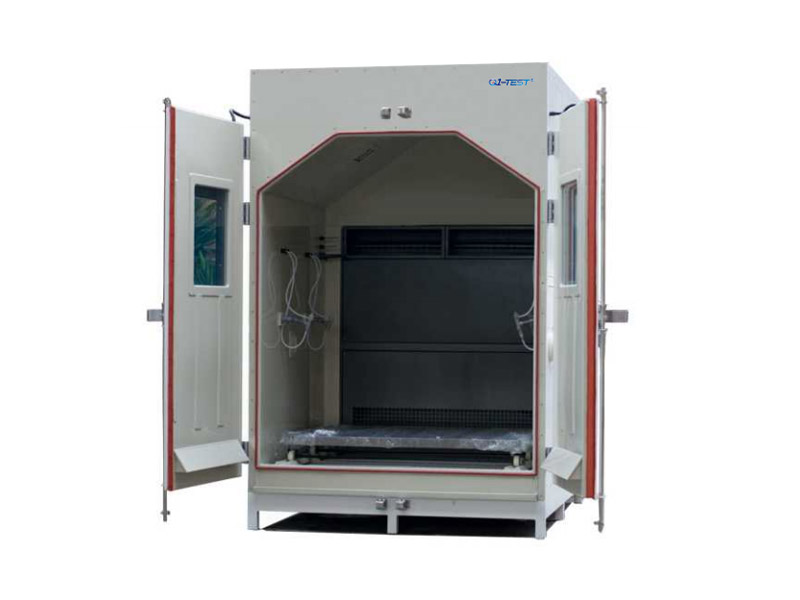
Entering the composite salt spray test chamberIntroduction
The step in composite cycle corrosion test chamber is mainly used to control salt spray, temperature, humidity, condensation, and spray tests. It is mainly targeted at large products such as aviation, high-speed trains, automobiles, casings, battery packs, solar panels, and other large workpieces and tooling equipment for salt spray testing and CC T composite salt spray testing.
The following standards are met:
GB/T 10125-1997 "Corrosion Test in Artificial Atmosphere - Salt Spray Test"
GB/T 10587-2006 "Technical Conditions for Salt Spray Test Chamber"
GB/T 1771-2007 "Determination of neutral salt spray resistance of paints and varnishes"
GB10593.2-1990 "Methods for measuring environmental parameters of electrical and electronic products"
QB/T 3826-1999 "Corrosion resistance test method for metal coatings and chemical treatment layers of light industrial products - Neutral salt spray test (NSS) method"
QB/T 3827-1999 "Corrosion resistance test method for metal coatings and chemical treatment layers of light industrial products - Acetic acid salt spray test (ASS) method"
GB/T 12967.3-2008 "Methods for Testing Anodic Oxidation Films on Aluminum and Aluminum Alloys Part 3: Copper Accelerated Acetate Salt Spray Test (CASS Test)"
GJB 150.11A-2009 Military Equipment Laboratory Environmental Test Methods Salt Spray Test
Product Features
1. Refrigeration adopts the separate design of refrigeration system and spray system, including anti-corrosion refrigeration components and touch control system.
2. Double door design, conducive to placing large samples
3. Non reactive door handle switch, dry seal with sealing strip
4. Two layer sample placement design and inverted trapezoidal inner box design
5. Thermal stable, high-performance salt spray atomizing nozzle
6. Precision salt spray collection device
7. Automatic air blowing device interlocked with top cover
8. Independently developed programmable controller interface